Sunday, 5 February 2012

Saturday 4th February 2012 - A wintery weekend in Staffs


Little bit of music for you today


Following the lowest overnight temperatures of the winter so far, Saturday started off at Westport. Other than increase the numbers of Tufted Duck and Pochard, the recent cold snap brought nothing new into Westport, and as per usual, the duck numbers then slowly drop day by day. The only area of open water was in the centre of the lake, and is becoming smaller by the day.

As we were walking round, news came from Belvide that the previous nights roosting GLAUCOUS GULL was still present. We decided to leave Westport and head straight down. There was a slight delay on the motorway so we headed through Stafford, adding about 15 minutes to the journey. Then the inevitable happened, and as we were leaving the M6 at Gailey, we found out that the GLAUCOUS GULL had flown off.

As we were so close, we diverted to Gailey to look for the BLACK REDSTART. We met up with the Snapper but there was no sign of the BLACK REDSTART or the regular MED GULL. It was still only 0930hrs and we were struggling as to where to go next.

I checked the sat nav and found that Stubbers Green was only 8 miles away. We'd never been before and so we headed down. We found the pool, but I couldn't really see where to park the car. I had a quick walk around but there were only a few gulls, and these were sat on the ice. You could see a constant movement between there and the tip, and you could sense a decent gull could drop in at any moment. But at least I can stay say I've been to Stubbers now. As we drove away, we passed a sign welcoming us back into Staffordshire. Strange I thought as some of the poor map readers from South Staffs think Stubbers is in Staffs!

And so on to Branston GP's next. We hadn't really seen much so far today, and as I was walking across the sheep field, I received news that the BLACK REDSTART had been seen at Gailey and there was an ICELAND GULL at Stubbers. Super I thought. The first pit at Branston was mainly frozen except for a small area right next to the footpath. I stood by the stile and counted what I could. Most of the birds I did flush did a circle and dropped back in. I then walked along the path and a wader flew off from the shore. I was most surprised to find it was a Knot and I watched it fly to the other side and land. A site tick for me! I met up with GAS and we grilled a flock of 60 Redpoll, but I just couldn't fudge any of them into a Mealy. We didn't expect much on the Sandy Pit, but as I scanned the reeds, I spotted two Snipe. I realised one of them wasn't a Common, and we were soon enjoying good views of a bobbing Jack Snipe. The day was slowly becoming not bad after all.


Jack Snipe at Branston GP's. Usual prices apply but limited to only one per person.


The snow was forecast to hit us at 15-00hrs, but I was aware it was already snowing in Stoke. I headed to the last pit of the day. I started working my way round, seeing 464 Pochard including the leucistic bird. Then it started to snow, but I battled on. In near blizzard conditions, I found the drake Smew again. A perfect bird for a snowy day.

Sunday and I had to battle through four inches of snow to get to Westport. Fortunately the main roads were clear of snow. We had 25 Lapwing on the ice, but it was quite foggy, and duck counting was tricky. During the afternoon, I checked my emails and found that matt4scfc had seen a Knot and two drake Pintail at 3pm. It was by now nearly 17-00hrs and going dark. I hurtled down, but it took me three different platforms before i found the Knot, feeding among the Mallard. I phoned PJ and GAS and they both saw it in the fading light as it roosted on the ice. Eventually I managed to get hold of CJW, and we waited for him to run down. He managed to see a small blob on the ice in the rapidly fading light.

This is the 7th record of Knot at Westport.
1990- 1st record – One flew south Dec 15th
1993- One on Apr 4th
1993- One Sept 8th
2000- One flew around and was chased off by Black-headed Gulls on Sept 26th
2001- One flew through on Dec 30th
2005- One standing on the ice on Dec 30th
2012- One roosted on the ice on February 5th.


PJ kindly produced this artists impression of the Knot at Westport

Sunday, 29 January 2012

Saturday 28th January 2012 - A decent day in Staffordshire

We decided on another day in Staffordshire today. Unfortunately, despite all week hoping he was having the weekend off, CJW had to work and so was unable to join us.
The day started off at Westport as per usual, but even with the presence of PJ, it wasn't very productive, and the quiet start to the year continued at the Golden Pond.
Then, I thought I had better pop into Fenton Park to see the LESSER WHITETHROAT again, having not year ticked it yet. Mr Birding Frontier aka Martin Garner had been down to see it recently and had written an interesting article on it, suggesting it was indeed an EASTERN LESSER WHITETHROAT. We walked down to the sunken garden and stood and waited. I started to wonder how long would it be for it to appear and how long were we prepared to wait for it, when, as if by magic, it appeared it the trees above us. Lesser Whitethroat -A January tick and all done and dusted in two minutes. Talk about tick and run!

Next target bird was the female RED-CRESTED POCHARD at Copmere. This wasn't so easy, mainly due to the fact that viewing the lake is a nightmare. There is just no clear view - its always through the trees. Even Roy Wents watchpoint is obscured by trees. We eventually went down to the bottom where the fishermen go in and eventually found the Red-crested Pochard. Excuse the photo, I had a tree blocking my view.

Red-crested Pochard at Copmere (or Cockmere as it was put out on Birdnet)

We were on a roll now, but we felt the next target wouldn't be as easy. We headed to Belvide for the 1w drake Scaup. Now this bird could have been anywhere but luckily, I found it from the first hide, showing distantly in the corner. No photo's of this I'm afraid.

Off to the Pits next, and some proper birding for a change. We popped into Whitemoor Haye on the way, seeing two Grey Partridges, the two Little Owls showed a treat and we also added Tree Sparrow and Yellowhammer to our Whitemoor day list.


Little Owls at Whitemoor Haye

Branston GP's was not bad despite quite a bit of shooting going on in the area. We faced the task of getting through Dead Mans Wood mid Pheasant shoot, but fortunately it stopped just as we approached, and we had a nice chat with the gamekeeper. He had no complaints it was good to hear. We also didn't end up in the pot, which was also quite good. We had 97 Golden Plovers, a Green Sandpiper, three Ruff, two Redshank and a Kingfisher.


Two of the three Ruff, two Redshank and a Curlew at Branston

We finished off the day very nicely by watching a drake Smew and two Egyptian Geese, plus a sign of spring with my first Staffordshire Oystercatcher of the year. A fine day where everything fell into place so nicely.

Drake Smew

First Oystercatcher back in Staffordshire

Heron in the late afternoon sun

Record shot of two Egyptian Geese - magical birds!

Friday, 27 January 2012

Thursday 26th January 2012 - Elton Hall Flash

It had been a funny week. I was getting up at 0400hrs everyday, and so I was able to do a little bit of birding on some afternoons. The only highlight from the beginning of the week was the appearance of a funny hybrid goose at Westport, probably either a Bar-headed x Barnacle or a Bar-headed x Farmyard. It only stayed two days, so it was probably a genuine hybrid.

On Thursday 26th, news came through at 11-30hrs that the GLOSSY IBIS was again at Sandbach. This bird was proving to be a bit of a bugger, and had only reappeared in the last few days following a ten day absence. This was my first visit for it, but CJW had dipped on it once before, and GAS twice before! It was getting personal between some of the Clayheads and this bird.

We arrived at Elton Hall Flash at 12-30 but there were only two birdwatchers on site, and they were looking at Pumphouse Flash. We were told it was on the left of Elton Hall Flash, but all the birds were being repeatedly flushed by something, and we just knew it wasn't on that flash, as at one stage, every bird was in the air. We walked down to the Pumphouse Flash, only to be told it was on the left back up at Elton Hall. Then we realised it was on the left hand side of the road (opposite EHF), in a flooded area. We walked back up again and there was the Glossy Ibis walking just a few feet away from us behind the wood. We were looking through the trees and so it was probably unaware that we were standing there, but viewing was tricky through the branches.


The view through the trees with the Ibis on show.

GAS and CJW finally catch up with the evasive Ibis. A Cheshire tick for both!


Glossy Ibis at EHF


We finished off the short visit with a check through the gulls on Pumphouse Flash, having good views of the sleeping 1w Iceland Gull.


Iceland Gull on Pumphouse Flash

PJ visited Sandbach Flashes on the 28th January when the Glossy Ibis was showing a little bit better. His pictures are below.

Friday, 20 January 2012

Friday 20th January 2012 - A rainy day

It rained today, all day. Infact, it was raining when I left the house at 05-00hrs this morning and it never stopped. The news that a GREEN-WINGED TEAL was a Sandbach Flashes caused us to head up there, despite the weather. It was actually only raining lightly when we arrived, and I soon found it sitting on the bank right at the back of Elton Hall Flash. There were also four BLACK-TAILED GODWITS.


The Green-winged Teal at Sandbach Flashes.
Then it was onto wet, rainy Westport. Its a bit of a struggle at Westport at the moment, as nothing it really happening there at the moment. Today, the Fowlea Brook was quite swollen, and that was about as good as it got.


Sunday, 15 January 2012

Saturday 14th January - Another grip back in Hampshire

News broke late on Monday 9th January of a SPANISH SPARROW in Hampshire. At first before the news was fully released, I had visions of it being on private land and seen in 1990 or something similar. But when the news was released, it was in someones garden in Calshot. It had also been around since early December 2011, and there were also reports of hybrids in the area, suggesting it had been around a lot longer. Before access arrangements could be made, the SPANISH SPARROW was seen the following morning from the road, and so there was no need for a repeat of last years ORIENTAL TURTLE DOVE queuing to get in a house.

Although I had to wait all week before I could go, it wasn't a nervous wait. I just made sure all the arrangements were in place and nothing hopefully could go wrong. There was also a very healthy supporting cast in the area with the DARK-EYED JUNCO nearby, a FERRUGINOUS DUCK, CATTLE EGRET, RING-BILLED GULL etc. Hopefully it would be another good day's birding. PJ had seen the Cumbria SPANISH SPARROW way back in the 90's and so it was just myself, GAS and CJW who headed down for the Hampshire Bird Fest, setting off at the incredibly early 03-30hrs.

It was a cool night, with temperatures as low -5.5C on the journey down, but at least we didn't experience any of the predicted fog. We arrived at Calshot at 07-00hrs when it was still dark. We were met by a car park attendant, resplendent in a high viz vest who came over to us, setting the scene, telling us what time it would appear and where we could get food from. All in all, it was an highly organised affair.


ABOVE - We really felt at home round here. The houses were exactly the same as the ones back in Stoke - even the same types of boats parked in the gardens.


Above - the expectant crowd standing around in the early morning

We set off in the dark so that we could get a good place, and we stood on the verge in front of the hedge, and waited for it to get light.We thought we were really lucky to get such a good vantage point, especially as the crowd started to grow - that was until the organiser came up to us to say we were stood in front of its favourite perch (we were facing the wrong hedge as well). At 08-10hrs, I sensed mumblings, movement and pointing from the roadside, and sure enough the Spanish Sparrow was sitting deep inside a hedge.


Above - The Calshot Spanish Sparrow - its first showing of the day.
It eventually flew out, and showed better in the hedge just in front of us.


Above - the Spanish Sparrow showing out in the open at last

It then flew off into the gardens, and didn't show again for quite a while. There were a few other birds in the area to look at while we waited. Two Green Woodpeckers flew over and a Peregrine was sat on the power station chimney.

ABOVE - A Peregrine on the chimney (I was laughed at when I took this potential Steve Seal frame-filling shot).

The Spanish Sparrow was relocated in the hedge by the village hall. I walked round to join the crowd in the car park, and had decent views again. We decided however, that we would leave now, while it was still showing, so as to be ahead of the pack at the JUNCO site. (We just knew everyone would be doing the same circuit as us, and the JUNCO was the logical next stop).

ABOVE - the crowd in the car park


And so with our first tick of the year safely tucked in our belts, we headed off into the New Forest, and to Hawkhill Inclosure. We had received no news on the JUNCO yet, but when we arrived we could see quite a healthy gathering in the clearing just beyond the car park. As we walked over, some of the crowd were suddenly moving, and some were running. As soon as we were in place, the Dark-eyed Junco came into view and we all enjoyed our 2nd British Dark-eyed Junco. It was to be a very enjoyable session, we some cracking views as the Junco kept appearing and disappearing, flitting around the area, loosely associating itself with a small Reed Bunting flock. We also had three Crossbill drop in, one a cracking red male.


ABOVE - The 1st winter male Dark-eyed Junco in the New Forest


ABOVE - A New Forest Pony

Next stop was at Blashford Lakes for the FERRUGINOUS DUCK. We had a bit of a nightmare finding this place (mainly due to the appalling internet coverage in the area, I just couldn't get my phone to work to find out where we were). Eventually after asking two people, the second one a birder, we found the reserve. The car park was full, and the place was heaving. We found the hide, only to find it full, but we just about managed to perch at the back. We had only just started to scan and settle in when a warden came in a kindly requested that if at all possible, could we please vacate the hide (if we wanted to) as a party of children were coming in. We duly obliged.

ABOVE - This was as good as it got with the Ferruginous Duck I'm afraid.


ABOVE - Loads of birdwatchers on site, no doubt attracted by the 450 different types of feeders dotted all over the reserve.

We could have stayed longer to be honest at Blashford, but we decided to head over to Warblington for the CATTLE EGRET that had already been reported during the morning. It was a 45 minute drive across Hampshire, and on arrival things looked promising with six Little Egrets feeding in a field, but we just couldn't turn any into a CATTLE. We met some locals who assured us it was a creature of habit, and she promised that it would return to the cattle field as it was high tide soon. We had a little walk around the area while we were waiting, seeing 500+ Dark-bellied Brents plus Red-breasted Merganser, Wigeon, Shelduck, Teal on the sea. There was also a pair of Gadwall (can't recall seeing one on the sea before). We hung around until 15-00hrs and then we decided to head for home. It had been another cracking day, and the CATTLE EGRET was the only blip. At 15-45hrs, as we were hurtling up the A34, we received news that it had indeed returned.

ABOVE - A pair of Gadwall sat on the sea


ABOVE - Brent Geese feeding at Warblington

Saturday, 7 January 2012

Saturday 7th January 2012 - Out and about in Staffs

We decided to head out into Staffordshire today. After a quiet week, there appeared a mass of reports on Friday which meant we had loads of target birds to see. There was the LESSER WHITETHROAT and LONG-EARED OWL in Stoke, two BLACK REDSTARTS at Gailey and Blithers, WATER PIPIT and WHITE-FRONTED GOOSE at Doxey, the photographers favourite GREAT GREY SHRIKE, plus a visit to the A38 corridor of pits. I realised that we probably had too many targets planned for the day, and we would probably miss a few of them, and we did!

Westport didn't take long as there wasn't much too see - it was also quite windy and rainy there again. We decided to skip the local birds and headed down to Doxey. As we parked up, there were quite a few cars turning up, and people getting out with binoculars. I thought that maybe the WATER PIPIT was attracting quite a crowd, but then it suddenly dawned on me what was going on - it was an organised walk! We quickly grabbed our stuff and headed off, just before everyone could start smiling at us and saying things like "Morning" and "Hello". It was quite embarrassing that some people thought we were coming on the walk as well. A close shave indeed.

The problem with Doxey today was that it was extremely windy again. All the geese were spread out, in ditches or just with their heads down. We couldn't find the WHITE-FRONTS anywhere. The paths to the WATER PIPIT zone were also quite flooded. Fortunately we were armed with wellies, and luckily, the guided walk party didn't follow us. But the WATER PIPIT just wasn't going to show today with such a strong wind. We did have a pipit sp fly up from the Pensioner Pollards, but it didn't call, and it landed in long grass. We did see a pair of Pintail and eleven Barnacle Geese, but not much else.

We had spent a little bit longer at Doxey than we planned, and so we decided against going to Blithers for the BLACK REDSTART as I thought that it could be tricky to find in the strong wind. We headed for Upper Longdon instead. On arrival, things looked a little bit bleak. The lay by was full of cars and there were birdwatchers and photographers literally scattered all over the area. We decided to head down into the valley where it would be quieter and more sheltered. We walked down with Hughie King, but had only walked a few yards when I spotted the Great Grey Shrike flying in low over the heather. It perched briefly, then it proceeded to hover. Never seen a shrike do this before, unless it was the wind that caused it. We also met another one of the long lens boys who'd said he'd taken over 700 shots of the bird so far.....


The stump on the right is one of its perches


The Upper Longdon Great Grey Shrike - nicely digiscoped from a safe distance

Next stop was in the A38 corridor set of pits. Full of Coot and Wigeon again, plus nearly 400 Lesser Black-backed Gulls were pre-roosting. Over 80 Pochard was a good count, but only four Goosander and 10+ Goldeneye were rather low. A pair of Pintail were the highlight.

With just enough light left, we hot footed it down to Chasewater for the roost. I realised why I find gull roosts so much fun after standing still for an hour and a half in a cold, icy wind, slowly getting colder and colder. RP struck first blood with an adult Med Gull, showing quite well.

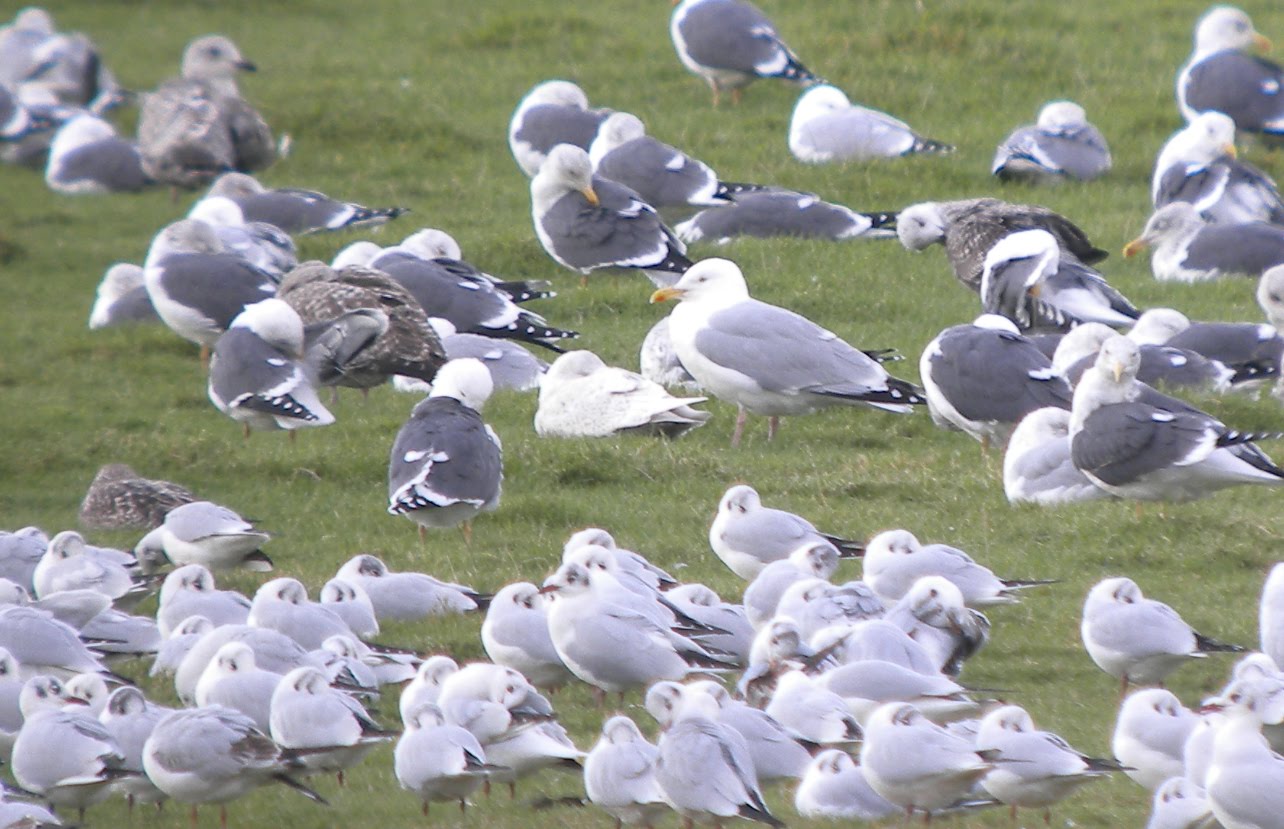
Now excuse time and I do apologise for the quality of the next photo, but the light was fading. The picture illustrates the problem with gulls. One Herring is in immaculate s/pl and the other has an almighty dark hood. But they are the same species!

Next up was a sub adult Iceland Gull that I found, but only later did it come into the main roost and showed well. It wasn't the best of roosts as most of the big gulls decided to roost on the shore in a mass huddle. There could have been more white-wingers about, but we just couldn't see them!